
Stanford team finds a way to help bleached corals recover in weeks
Good news
Good news
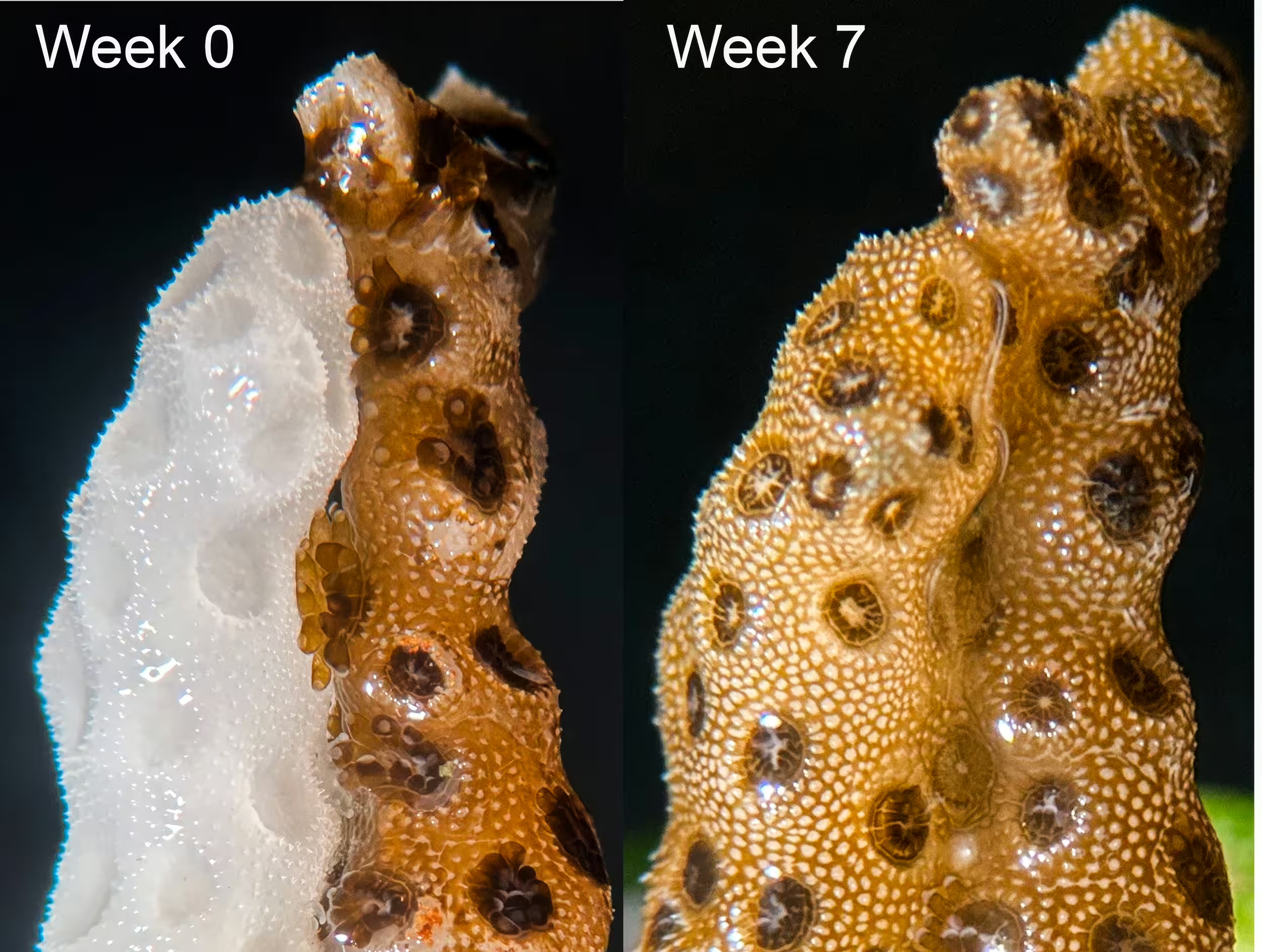
- Project or resultBleached coral fragments recovered fully within seven weeks after contact with healthy fragments from the same clone in Stanford laboratory experiments.
- Reported resultsFull recovery in the laboratory: 7 weeks · Beneficial algae observed moving between corals: 3 days · Shortest contact that started recovery in some tests: 5 days
- Location contextRepresentative global reef locations for coral-bleaching context; approximate regional markers only, not Stanford study sites. NOAA reports bleaching-level heat stress across about 84.4% of global reef area and mass bleaching in at least 83 countries and territories from 2023 to 2025.
What changed
First retained snapshot
No earlier verified snapshot is present in the recovered dataset. This record remains available as the historical baseline.
Situation
Bleached coral fragments recovered fully within seven weeks after contact with healthy fragments from the same clone in Stanford laboratory experiments. Beneficial algae and nutrients began moving between their tissues within three days; in some tests, five days of contact was enough to set recovery in motion.
Coral reefs support food and livelihoods for hundreds of millions of people and help protect coastal communities from storms and flooding. The finding is promising, but it is not yet a reef-scale treatment: each bleached coral would need a healthy, genetically identical partner. The researchers say that requirement makes the method impractical at the scale needed to restore reefs. Published in Science Advances on 14 October 2026, the study offers restoration teams a new lead to investigate alongside approaches that can work across entire reefs.
WorldsAid verification
A WorldsAid editor checked this project story against 2 attributed Stanford Doerr School of Sustainability source pages. Its mapped location is labelled: Representative global reef locations for coral-bleaching context; approximate regional markers only, not Stanford study sites. NOAA reports bleaching-level heat stress across about 84.4% of global reef area and mass bleaching in at least 83 countries and territories from 2023 to 2025.. Results are presented as organisation-reported where applicable.
Verified figures
- Full recovery in the laboratory
- 7 weeks retained at 2026-10-21
- Beneficial algae observed moving between corals
- 3 days retained at 2026-10-21
- Shortest contact that started recovery in some tests
- 5 days retained at 2026-10-21
What we knew when
- WorldsAid record entered the retained historical dataset.
- Stanford report reviewed: same-clone coral fragments recovered fully within seven weeks in laboratory tests; transfer began within three days. The authors caution the approach is not scalable across reefs because it requires a healthy genetic match for each bleached coral. preserved as a dated, source-linked observation. Source
Earlier figures are never replaced by later values; additional observations are retained as new ledger entries.
Provenance
This page renders the last verified WorldsAid cache directly in HTML. It does not treat generated summaries as primary evidence.
Cached dataset: worldsai_drup771.sql.gz
Verified
SHA-256 08d1bb7e61e4403b8741f20d83f931226b3959b9b40e4dbb369a6360d5c908fc