
Costa Rica’s forests are returning, with thousands of families part of the story
Good news
Good news
- Project or resultCosta Rica’s forest recovery is one of the clearest examples of a country changing course after decades of tree loss.
- Reported resultsForest area of land · FAO/FAOSTAT, 2024: 59.1% · Families benefiting from environmental-service payments · 1997–2019: 18,000+
- Location contextCosta Rica · national forest-cover trend; the supplied image does not identify a specific site or protected area.
What changed
First retained snapshot
No earlier verified snapshot is present in the recovered dataset. This record remains available as the historical baseline.
Situation
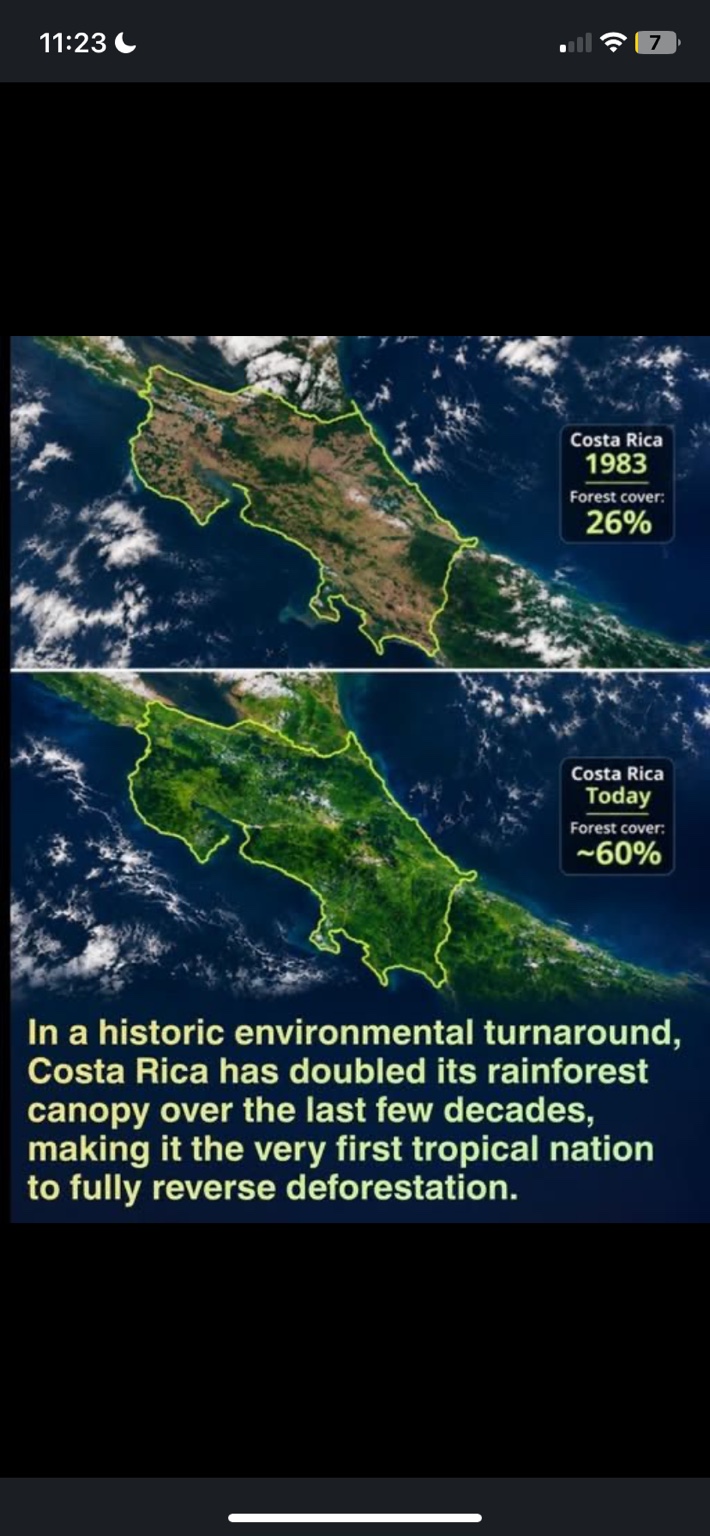
Costa Rica’s forest recovery is one of the clearest examples of a country changing course after decades of tree loss. The latest FAO series, published through the World Bank’s indicator database, records forest area at 59.1% of the country’s land area in 2024. That is a substantial recovery from the low estimates reported for the 1980s, though the precise starting point depends on how forest cover was measured.
Behind the national figure are choices made by people who live and work on the land. Costa Rica’s Payment for Environmental Services programme pays landowners for protecting forests and supporting reforestation, sustainable forest management and agroforestry. The UNFCCC reports that more than 18,000 families benefited from the programme between 1997 and 2019, including Indigenous communities and family associations. Beneficiaries have used payments for essentials such as food, medicine and schooling, and for projects in their communities.
The viral graphic supplied with this story captures the broader direction: Costa Rica is greener than it was during the worst period of forest loss. But its “26% in 1983” baseline is disputed. A Costa Rican University fact-check traces that figure to an older estimate and describes later research that put forest cover at 40.8% in 1986. The graphic’s dramatic before-and-after comparison therefore overstates how much forest was lost and then regained. A FONAFIFO publication did reproduce the 26% figure, but that does not settle the underlying measurement question.
The recovery also remains unfinished. The OECD says forests still cover less land than in 1940, and warns that forest fragmentation and renewed conversion to pasture, crops and urban areas remain concerns. The good news is not that every forest has returned to its original state; it is that policy, conservation and people’s livelihoods helped make recovery possible, and that protecting what has returned still matters.
WorldsAid verification
A WorldsAid editor checked this project story against 6 attributed Costa Rica · FONAFIFO / national conservation programmes source pages. Its mapped location is labelled: Costa Rica · national forest-cover trend; the supplied image does not identify a specific site or protected area.. Results are presented as organisation-reported where applicable.
Verified figures
- Forest area of land · FAO/FAOSTAT, 2024
- 59.1% retained at 2026-11-23
- Families benefiting from environmental-service payments · 1997–2019
- 18,000+ retained at 2026-11-23
What we knew when
- WorldsAid record entered the retained historical dataset.
- FAO/FAOSTAT forest-area series through 2024, World Bank policy and payment programme reporting, OECD forest-cover context, FONAFIFO historical graphic, and University of Costa Rica fact-check reviewed. The 26% 1983 baseline is explicitly treated as disputed. preserved as a dated, source-linked observation. Source
- UNFCCC programme page reviewed: more than 18,000 families benefited between 1997 and 2019. These are programme beneficiaries, not a count of people directly affected by this story. preserved as a dated, source-linked observation. Source
Earlier figures are never replaced by later values; additional observations are retained as new ledger entries.
Provenance
This page renders the last verified WorldsAid cache directly in HTML. It does not treat generated summaries as primary evidence.
Cached dataset: worldsai_drup771.sql.gz
Verified
SHA-256 d2d90e168302d49219b6cc01e98598064461d1c88420a39c6b57887e387ca566- World Bank · Forest area (% of land area), Costa Rica · FAOSTAT series through 2024
- World Bank · Costa Rica’s Forest Conservation Pays Off · 16 November 2022
- UNFCCC · Costa Rica Payments for Environmental Services Programme
- OECD · Environmental Performance Reviews: Costa Rica 2023 · forests and land use
- FONAFIFO · Costa Rica: Tropical Forests, Ecological Growth Generators · historical forest-cover graphic
- University of Costa Rica · Doble Check: the 26% baseline and historical forest-cover estimates · June 2019